Getting Started
This guide will help you get your first band structure calculation running in under 5 minutes.
Installation
using Pkg
Pkg.add("PhoXonic")
Pkg.add("Plots")  # For plotting
Your First Calculation: 2D Photonic Crystal
See also: examples/101_triangular_rods.jl
Let's compute the band structure of a 2D photonic crystal with dielectric rods in a triangular lattice.
Step 1: Define the Structure
A triangular lattice photonic crystal with dielectric rods (ε = 12) in air.
using PhoXonic

# Create triangular (hexagonal) lattice with period a = 1
lat = hexagonal_lattice(1.0)

# Define materials
air = Dielectric(1.0)
rod = Dielectric(12.0)  # High dielectric (e.g., GaAs or Si)

# Geometry: air background with dielectric rod at center
geo = Geometry(lat, air, [(Circle([0.0, 0.0], 0.2), rod)])
Step 2: Create Solver and Compute Bands
# Create solver for TM polarization
solver = Solver(TMWave(), geo, (64, 64); cutoff=7)

# Define k-path: Γ → M → K → Γ
kpath = simple_kpath_hexagonal(; a=1.0, npoints=30)

# Compute band structure
bands = compute_bands(solver, kpath; bands=1:8)
Parameters:
(64, 64): Grid resolution for discretizing the unit cellcutoff=7: Number of reciprocal lattice vectors included (higher = more accurate but slower)
The returned bands object is a BandStructure containing frequencies, k-points, and labels. It can be passed directly to plot_bands and find_all_gaps. See Workflow for details.
Step 3: Find Band Gaps
gaps = find_all_gaps(bands)
for g in gaps
    println("Gap between bands $(g.bands): $(round(g.gap_ratio*100; digits=1))% gap-to-midgap")
end
Expected output:
Gap between bands (1, 2): 47.4% gap-to-midgapPlotting the Band Structure
using Plots

plot_bands(bands;
    xlabel = "Wave vector",
    ylabel = "Frequency (ωa/2πc)",
    title = "2D Photonic Crystal (TM)"
)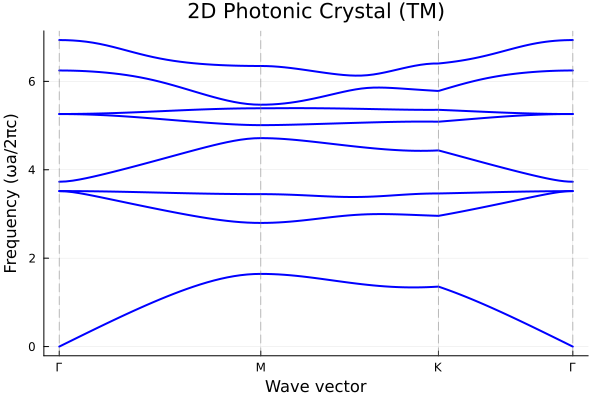
This band diagram shows a clear photonic band gap between the first and second bands (~50% gap-to-midgap ratio).
Next Steps
Now that you've run your first calculation, explore more:
- Workflow: Detailed workflow for 2D photonic and phononic crystals
- 3D Calculations: Full vector EM and elastic wave calculations
- Examples: Complete example scripts with various structures
- Solver Methods: Choose the right solver for your problem size
- API Reference: Full documentation of all functions